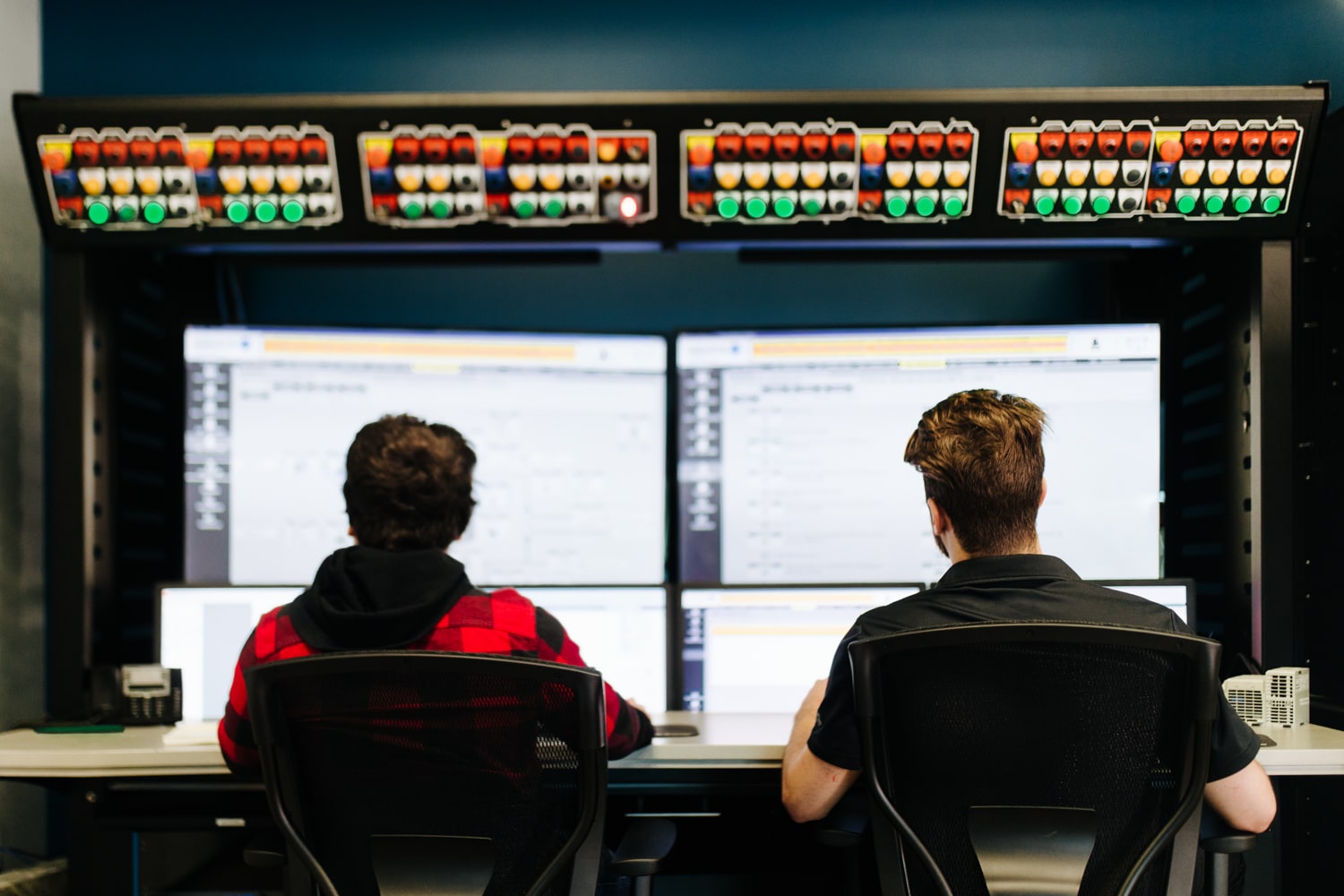
Industrial Programming

Increase productivity with our expertise in industrial programming
Our team of highly qualified programmers can work on a wide range of industrial controllers (PLC, DCS, SIS), human machine interfaces, and supervisory controls and data acquisition systems.

A strong expertise in industrial programming at your disposal
Our industrial programming team comes from a varied set of industrial backgrounds. Their expertise and reputation are based on training and sharing of knowledge and competencies.
We program:
- Programmable logic controllers (PLC)
- Distributed control systems (DCS)
- Safety Instrumented Systems (SIS)
- Axis and robot controllers
- Human machine interfaces (HMI)
- Supervisory Control and Data Acquisition (SCADA)

Reliable, scalable, and tailored programming standards to fit your needs
We rigorously adhere to our clients’ programming standards. In addition to mastering the object libraries provided by PLC and DCS manufacturers, we have developed our own Excelpro standards for process control: function blocks, symbols, and popup windows.
These libraries are:
-
Validated on multiple control platforms and SCADA systems
-
Rich in analysis features
-
Designed to be easily modified and adapted to your requirements
-
Scalable, maintainable, and aligned with industrial best practices
They represent a strategic advantage for systems that are more reliable, more efficient, and easier to maintain. Whether you are working on:
-
A new process emerging from R&D
-
A new installation
-
Equipment upgrades (retrofit)
-
The optimization of equipment or a production line
… our team brings its expertise to develop robust, scalable, and high-performance systems.

A rigourous programming process
At Excelpro, every programming project follows a methodical process that ensures the reliability, safety, and performance of the final system. We begin with an in-depth analysis of functional requirements to define the programming standards, sequences, and control logic needed.
Analysis, design, and programming engineering
Our teams carry out:
-
The detailed specification of programming standards and conventions
-
Programming engineering: sequences, control loops, functional descriptions
-
The definition of operating modes for each piece of equipment
-
The configuration of alarms, permissives, interlocks, and protections
-
The associated documentation, essential for system maintenance and future evolution
This first phase ensures a complete understanding of the process and a solid foundation for precise, safe, and high-performance control.
We prepare all test and inspection plans, which are then validated by the client. We strongly encourage your participation in the FAT (Factory Acceptance Test) sessions. These tests make it possible to verify—before commissioning—that the programming meets your functional and operational requirements.
This is a key step to reduce risks, optimize quality, and accelerate on-site integration.
The SAT (Site Acceptance Test) marks the final validation of the system under real operating conditions. During this stage, we fine-tune the programming to:
-
Achieve the expected performance
-
Optimize cycle times
-
Ensure process stability
-
Verify compliance with operational and safety criteria
This final phase ensures that your installation is fully operational, reliable, and aligned with your production objectives.

A diversified expertise to successfully complete your manufacturing project